
Was sind die Vorbereitungen, um in eine Kohlenstoffherstellungsanlage zu investieren?
Most investors need a long preparation time to start a new charcoal plant because charcoal production is a large project, which not only requires sufficient funds but also chooses high-quality charcoal production equipment and learns comprehensive production technology. So, for a novice, what full preparations are needed to start a complete charcoal production plant?
Video der Kohleherstellungsanlage
Warum Shuliy-Kohleherstellungsmaschinen wählen?
Als Hersteller von Kohlenstoffherstellungsmaschinen bietet Shuliy Machinery nicht nur Geräte höchster Qualität für Kunden, sondern auch kostenlose technische Beratung, die alle Probleme bei der Kohlenstoffproduktion für Kunden lösen kann.
Während der Jahre der Produktion und des Verkaufs von Kohlenstoffmaschinen sind uns verschiedene Probleme von Kunden begegnet. Wir haben professionelles technisches Wissen genutzt, um Ihnen die sinnvollsten und effektivsten Erklärungen zu geben, um Ihnen bei der Lösung verschiedener Probleme während der Produktion und Nutzung zu helfen.
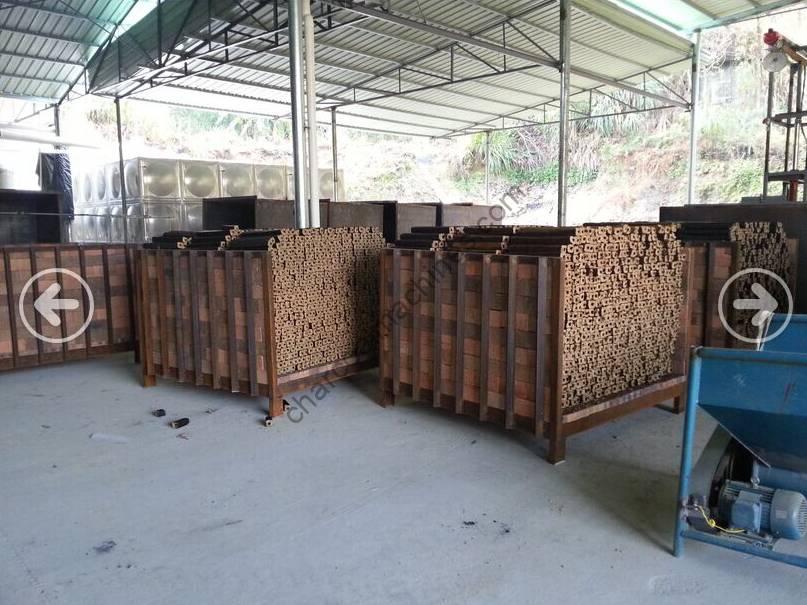
Faktoren, die beim Start einer Kohleanlage zu berücksichtigen sind
Eine vollständige Kohlenstoffproduktionslinie besteht aus Rohstoffen, Produktionseinrichtungen, Werkstätten, Arbeitern und fertigem Kohlenstoff.
Kohleverarbeitungswerkstatt
For charcoal production sites, usually not too large or too good sites are not required. For a charcoal producer with a daily charcoal output of 1 ton, it only needs a plant area of about 70 square meters. When the factory building is constructed, the height should be more than four meters, which can leave enough space for the equipment.
This area is mainly for host equipment, and crushing equipment and drying equipment for auxiliary production can be placed outdoors. Many charcoal machine manufacturers can customize the machine according to customer requirements, so the requirements of the plant are not the most important.
Rohstoffe
Die Rohstoffe für die Kohlenstoffherstellung müssen ausreichend und günstig sein. Häufige Rohstoffquellen: A. Forstwirtschaftliche Rückstände: Sägemehl, Holzspäne, Bambusspäne, Zweige, Rinde, Kiefernfrüchte, Nussschalen usw. B. Landwirtschaftliche Rückstände: Reisschalen, Hanfstängel, Maiskolben, Bohnensprossen, Sorghumstängel, Baumwollstängel, Baumwollhülsen, Sonnenblumenhülsen, Erdnusshülsen und härtere Stroharten. C. Industrielle Rückstände: Zuckeraldehydreste, geröstete Gummi-Rückstände, Saccharose-Rückstände usw.
Es gibt zwei Anforderungen an die Rohstoffe für die Kohlenstoffherstellung: 1. Die Rohstoffe müssen Körner sein, Körnergröße unter 3-6 mm. 2. Der Feuchtigkeitsgehalt der Rohstoffe darf 12 % nicht überschreiten.
Kohlemaschine und Strom
If the customer’s raw materials are not pellets, an additional grinder must be added. An additional dryer is required for raw materials with a moisture content of more than 12%. If the raw materials are not granules, 4 pieces of equipment, pulverizer, dryer, sawdust briquette machine, and Carbonisierungsofen are generally required.
The equipment for producing charcoal usually uses three-phase electricity. To produce 1t of charcoal, about 250 kWh of electricity is needed. If the customer’s raw materials are granules with a diameter of less than 1cm, 3 pieces of equipment, sawdust briquette machine, dryer, and carbonization furnace are required. It takes about 180 kWh to produce 1 t of charcoal.
Kommentare sind geschlossen.