
¿Cómo hacer carbón con el horno de carbonización por elevación de flujo de aire paso a paso?
The airflow hoisting carbonization furnace is composed of the movable outer stove, inner stove, airflow pipes, ignition port, hoisting equipment, and the flue gas purification equipment. The inner stove is independent so that the charcoal furnace can be a single inner stove, three inner stoves, and four inner stoves. The carbonization inner stoves are connected by pipes, and the combustible gas in the carbonization process can burn each inner furnace which has high working efficiency and can save fuel consumption.
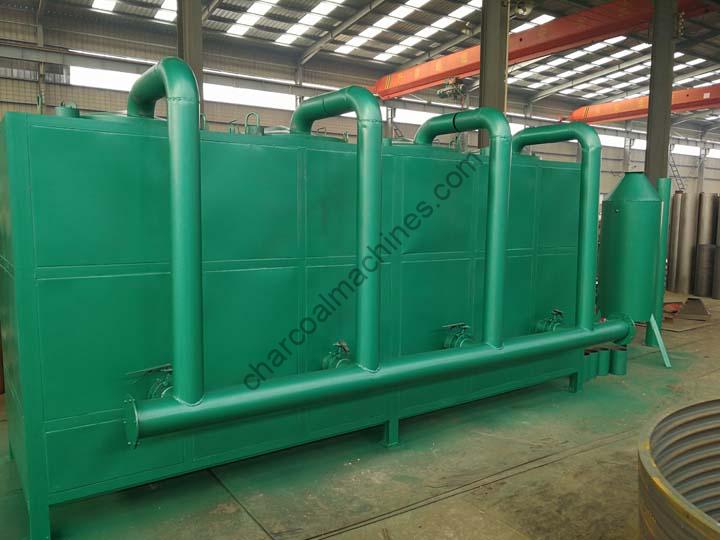
Los detalles del proceso para hacer carbón vegetal por el horno de carbonización con elevación de flujo de aire:
Etapa 1: proceso de secado
After placing the inner stove which is of the biomass rods in the carbón furnace, to ignite at the ignition port below the furnace, and the temperature in the furnace is gradually heated from normal temperature to about 100 °C. Because the temperature inside the furnace before ignition is low, this process should be heated with a large fire, reaching 100 degrees to the left, and then use a small fire to heat the carbonization temperature to 170 ° C – 200 ° C or so.
Etapa 2: proceso de pirólisis
Cuando la temperatura en el horno de carbonización alcanza los 170 °C – 200 °C, use un hervor para calentar la temperatura del horno a unos 340 °C. La segunda fase dura aproximadamente 2 horas y 30 minutos.

Etapa 3: proceso de pirólisis rápida
When the temperature in the furnace reaches about 340 °C, use a small fire to heat the furnace temperature from 340 °C to 380 °C – 400 °C. The third phase takes about 2 hours.
Etapa 4: el fin de la carbonización
Cuando la temperatura en el horno alcanzó unos 400 °C, no hubo cambios de temperatura significativos después. Use un fuego pequeño para calentar, cuando la salida de humo por la salida de humo se reduzca y se aclare significativamente, la llama se apaga y la carbonización termina. La cuarta fase dura aproximadamente 40 minutos.
Etapa 5: proceso de enfriamiento y descarga del carbón vegetal
After the carbonization is completed, if no other cooling measures are taken, the fire can be sealed and the charcoal can be naturally cooled. There are two ways to seal fires: Method 1: seal the smoke outlet and cool the charcoal, and the surface of the briquetas de carbón is good. This method takes about 16 hours to cool down the charcoal. Method 2: completely open the smoke outlet and cool the charcoal. This process is the same as method 1, but the charcoal surface is not shiny like the former. This method takes about 16 hours for cooling. In these two ways, when the temperature in the furnace drops to about 40°C, to discharge the charcoal is ideal.
Equipo de producción de carbón vegetal en venta

Note: If there is no temperature measuring device or temperature measuring device damaged in the horno de carbonización con elevación de flujo de aire, the small-fire firing in the carbonization process shall take 7-8 hours. It is strictly forbidden to use a large fire during the carbonization process. At the end of carbonization, when the amount of smoke from the outlet is significantly reduced and the smoke is light, the flame should be extinguished and the carbonization is over.
Sin comentarios.